|
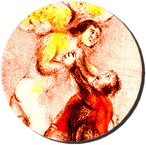
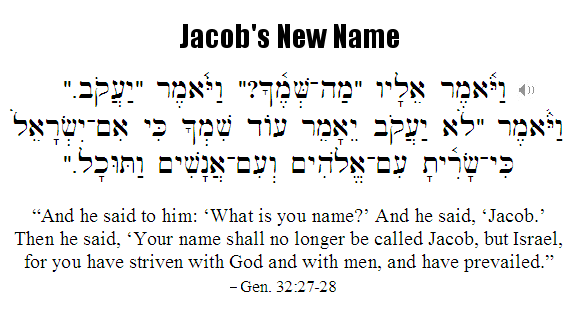
During the "grappling" (recall the meaning of Jacob's name), the Angel injured Jacob's thigh, but Jacob refused to release his hold until he received the blessing (הַבְּרָכָה). The LORD then asked him, "What is your name (מַה־שְּׁמֶךָ)?" And he said, "Jacob" (i.e., Ya'akov: יַעֲקב). The Angel then declared, "Your name shall no longer be Ya'akov ("heel holder" [of Esau]) but Yisrael ("contender with God"), for as a prince (i.e., sar: שַׂר) you have contended (i.e., sarita: שָׂרִיתָ) with God and with men and have prevailed" (Gen. 32:28).
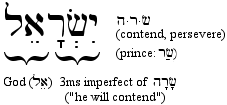 |
After Jacob (i.e., Ya'akov: יַעֲקב) was renamed Israel (יִשְׂרָאֵל), he asked the Angel for His Name, but was denied, since the Name is unutterable - even to one who had prevailed with God. Jacob then called the name of the place "the face of God" (i.e., Peniel: פְּנִיאֵל), saying "I have seen God face to face (i.e., panim el panim: פָּנִים אֶל־פָּנִים) and yet my life has been spared" (Gen. 32:30).
Later that morning, when Jacob saw Esau and his gang approaching, he placed each of his children in front of the child's respective mother: First the handmaidens and their four children; then Leah and her seven children; and finally Rachel with her only son Joseph (in the safest position). Jacob then went ahead of the entire family and bowed down seven times as he approached his twin brother. Miraculously, Esau ran to Jacob, embraced him, and they wept together. Jacob then introduced his wives and children.
Esau then asked about all the gifts that were sent to him, and told Jacob he didn't need them, but Jacob insisted that he keep them, "for I have seen your face, which is like seeing the face of God, and you have accepted me" (an oblique reference to his experience of "God wrestling" at Peniel the previous night).
Esau invited Jacob to live with him in Seir (in Edom), but he was still apparently distrustful of his brother and decided to move south to Sukkot, outside the city of Shechem. There he purchased some land from the sons of Shechem and built an altar to "God, the God of Israel" (i.e., El Elohei Yisrael: אֵל אֱלהֵי יִשְׂרָאֵל). After settling into the land, Jacob's only daughter Dinah decided to visit some of the local women but was abducted and raped by the crown prince of the city. After Jacob and his sons learned of the incident, the prince's father (Hamor) appealed for Dinah's hand in marriage to his son, and suggested that Jacob and his family intermarry with their family and enjoy the fruit of the land together.
Outraged by the violation of their sister, Jacob's sons devised a plan of revenge by feigning agreement with their plan - but stipulated that all the males of the city must undergo ritual circumcision (brit milah) in order for intermarriages to be acceptable. King Hamor and his son agreed to the terms and convinced the men of the city to undergo the circumcision ritual. But on the third day, when the men were in their most debilitated condition, Simon and Levi, Dinah's brothers, entered the town and executed all the men there, and the other brothers came and despoiled the city, taking all the livestock and wealth, and making slaves of the women and children.
After the destruction of Shechem, God commanded Jacob to return to Bethel (the place of his earlier vision and the place of his vow), where he built another altar to the LORD (Gen. 28:22; 35:1-7). God then (again) renamed him Israel and renewed His promise to give Canaan to his descendants.
Jacob then left Bethel to return to his hometown of Hebron (Chevron), but on the way Rachel died while giving birth to Jacob's twelfth son Benjamin ("son of the right hand") and was buried beside the road to Bet Lechem (Bethlehem). [The Jewish sages say that Jacob chose this site because he foresaw his descendants passing it on the road to the Babylonian exile, and Rachel would "weep for her children." Jacob's monument to Rachel is known as 'Kever (the Tomb of) Rachel'.]
Jacob then moved on and set up camp beyond the tower of Eder. It was here that Reuben, his firstborn son, slept with Rachel's handmaiden (and the mother of Dan and Naphtali from his father Jacob). [This would cost him his bechor status of Israel.]
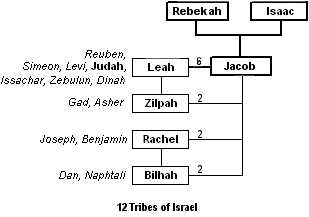
The parashah then lists the names of the 12 sons (shevatim) of Israel:
|
























![Genesis 32:3[4h] (BHS)](../../../../Scripture/Parashah/Summaries/Vayishlach/gen32-3.gif)